
Variety: Hokum Article
‘Hokum’: How Star Adam Scott and Director Damian McCarthy Developed a Protagonist Who’s a ‘Total A–hole,’ Dodged ‘Cheap’ Jump Scares and Conjured Real Horror on Set
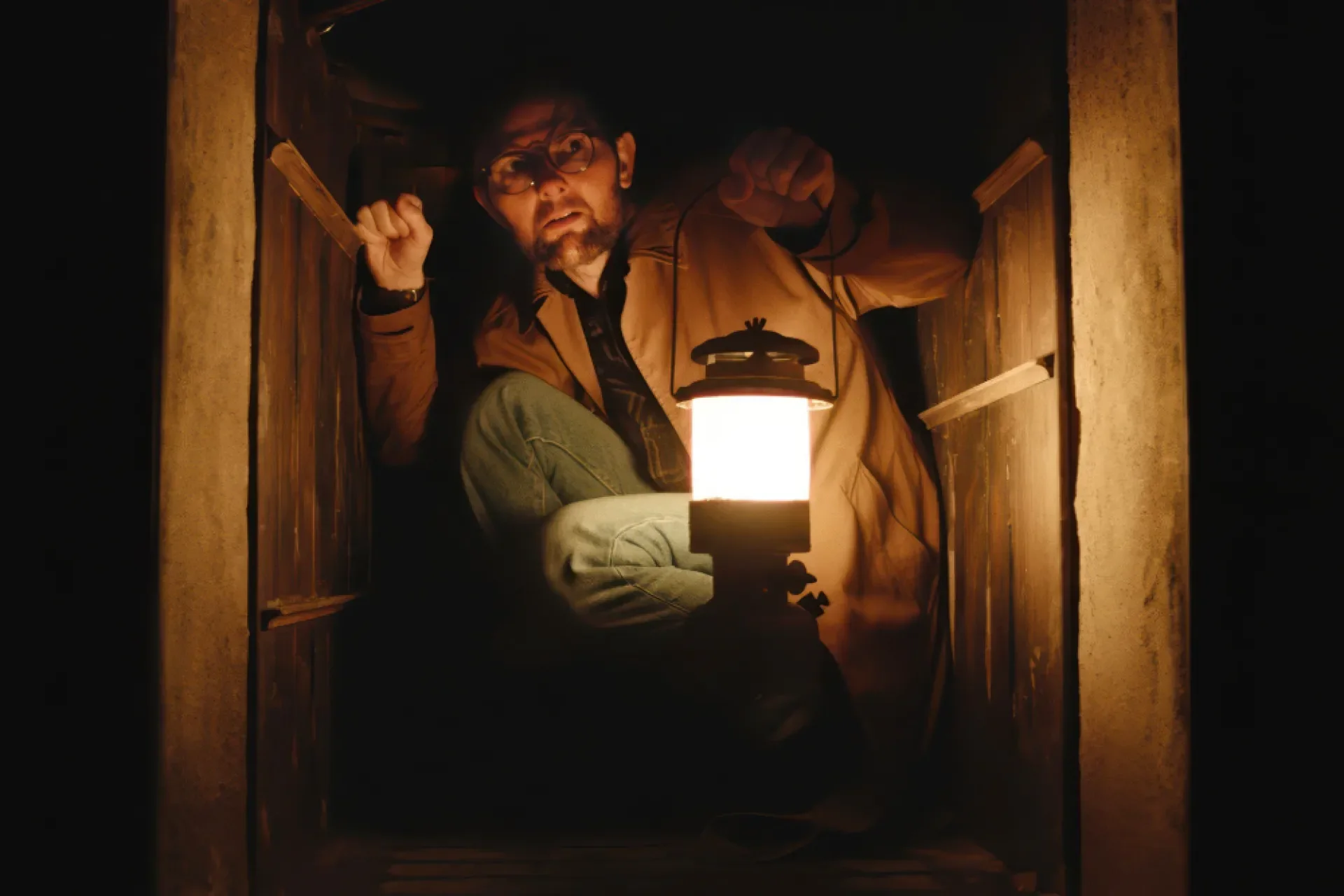
Adam Scott has played plenty of roles that have endeared him to audiences, anchoring series like “Parks and Recreation” and “Big Little Lies” with his charm and likability. Yet his new role burns it all down, as he portrays caustic and alcoholic author Ohm Bauman in the horror movie “Hokum,” in theaters today via Neon. Bauman becomes an unlikely detective, trying to solve the mystery of a haunted hotel in a remote Irish town. As answers get closer, the audience learns more about the darkness that has made him such a curmudgeon. But it was a gamble to make the lead such a grouch.“Part of why I was excited by the script in the first place is that it was taking this big swing of having the protagonist be a total asshole when the movie starts,” Scott says. “He’s rooting out this information about himself and figuring out how to maybe forgive himself or the people in his past, and the audience is doing the same. They’re learning to forgive him in real time, just as he is. We dove in headfirst, and [writer-director] Damien [McCarthy] didn’t want me to make him a charming asshole. This guy is a jerk when we find him. It’s always good to have the door at least an eighth open to let the audience in, but it can be unpleasant at first — as long as they’re interested.”
Having a prickly protagonist is one of the ways McCarthy upends expectations in a tale based in traditional horror. One of the key methods he used to conjure a spooky atmosphere was by paying tribute to his favorite films with his DP, Colm Hogan.
“I wanted to make a classic-looking ghost story,” McCarthy says. “Something that’s a lot of crushed blacks and warm yellows and oranges and has that tone to it. It’s lovely lighting on the face. And even though it’s a scary movie, you want the audience to enjoy watching it. I’ve never been a big fan of Giallo-type Italian lighting of extreme greens and reds. It’s something that wouldn’t work with this anyway. There should be textures and layers; it should feel old and worn. And maybe even the time period is a little bit vague. When exactly is this set? A few times, I said that the most interesting-looking prop, or a piece of clothing or fabric, is the winner. Even if it doesn’t necessarily all go together, if that looks great in front of the camera, let’s put it there. It’ll all make sense.”
One element that was crucial for McCarthy to nail was his use of jump scares. While there is a classical tradition of spooking audiences with sudden movement and loud noises, he wanted all of these moments to feel as earned as the film’s emotional beats.
“It’s the punchline to what you’ve been building up towards,” McCarthy says. “If it were just the punchline on its own, it would be a very cheap jump scare. There’s nothing earned about it. I like the way that, when they’re done well, you’re telling the audience, ‘The sequence begins now, and I’m telling you that something is going to happen within the next couple of minutes.’ And then it’s building up to that and trying to catch them. They think, ‘OK, here we go. He’s going to pull open the curtains. There’s going to be something there.’ If you did that, then that’s quite cheap, and there’s nothing inventive about that. But it’s the idea of continuously teasing it out … ‘When is that rubber band finally going to snap?’ That would always be my approach to it.”
One of the challenges Scott had in amping up the scares was using his character, the audience surrogate, to convey rising terror as he discovered more about the haunted lore of the hotel. That meant he had to conjure fear within himself in order to keep pulses racing — even during one long sequence when he was locked inside a room.
“Once we were shooting in the honeymoon suite, we were in there for two or three weeks of just me in a room,” Scott says. “The room acted as the other character, and we had the luxury of being able to shoot in sequence once we were in there. We were able to modulate and map out the trajectory, because you don’t want him to just be scared, and it’s this one level the whole time. You want to be able to tell the story and have different levels to it. There are points where he gets really scared and then it goes back down, and he becomes comfortable with his new reality. And then something even worse happens.”
In order to naturally act scared, Scott recalled a particularly unnerving artifact from his youth.
“I remember thinking about me as a kid after making the mistake at 10 years old of watching ‘The Atlanta Child Murders,’ which was a TV movie,” he says. “Boy, did that just turn my world upside down. I had nights where I was not sleeping — all I was doing was checking the locks on the doors in my house and wanting to make sure no one broke in and murdered all of us. That’s a permanent mark. You remember that, so that sort of thing certainly comes in handy.”
The pair’s plan to scare audiences has been working so far, as the film debuted at South by Southwest to a game, rowdy crowd. Other screenings, such as the genre-focused Overlook Film Festival in New Orleans, have been packed with vocal horror fans eager to visit the spooky Irish hotel. McCarthy considers himself to be a proud member of the genre community.
“I love horror movies. I just love watching them,” McCarthy says. “I love making them. They’re a lot of fun. They’re hard work, but they are fun to make, and they’re so rewarding, because when you go to a place like South by Southwest or any kind of a festival, it’s a thrill when you see people get that nervous laughter. I would like to continue making horror films for as long as I can.”
